
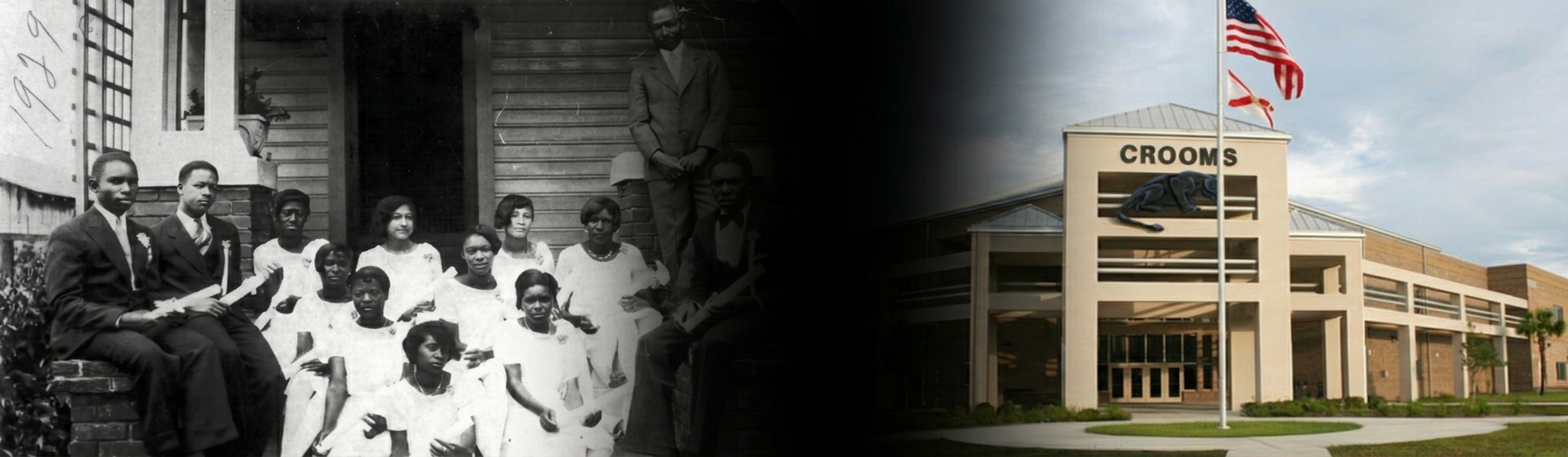

Crooms Centennial History | 1926–2026
Pre 1926: The Founders’ Vision
Joseph Nathaniel Crooms was born in 1880 in Orlando, the fifth child of Moses and Daphne Crooms. Trained at Florida Normal College (now FAMU) and Hampton Institute, Joseph arrived in Sanford in 1906 to lead Hopper Academy, then the only school for Black children in the area. He and his wife, Wealthy Richardson Crooms, a fellow educator and vice principal, donated 7.5 acres of their own land in the Goldsboro neighborhood in 1926 and built a new school at 2200 West 13th Street, the first four-year high school for Black students in Seminole County. The Seminole County Board of Education named it in Joseph’s honor. For the first time, Black students across Central Florida had access to a full secondary education in arts, sciences, music, and the humanities, all the way to graduation.
1926–1953: Excellence Under Constraint
Under Florida’s Jim Crow laws, Crooms faced many financial challenges including hand-me-down books and limited infrastructure. Joseph Crooms’ creativity and resourcefulness was necessary. He was a gifted pianist who taught choir at the academy; the curriculum encompassed visual arts, performing arts, and sciences alongside an academic program that sent graduates to HBCUs across the South. When accreditation required a certified library and librarian, Crooms raised the money himself, $7,300 gathered through appeals to teachers, parents, churches, and the Sanford business community.
The graduates Crooms shaped during these years went on to become a U.S. congressman, a university president, a city commissioner, and the first Black graduate of UF’s law school. After 27 years as principal, Joseph Crooms retired in 1953.
1954–1970: Desegregation and a School in Transition
Desegregation in Florida came slowly after Brown vs. Board of Education in 1954. Crooms continued to serve as the county’s designated Black high school through the late 1950s and into the 1960s, expanding its facilities with a football field. Edward L. Blacksheare, a Crooms c/o 1943 graduate, and Morehouse graduate who earned his master’s from Atlanta University - became assistant principal in 1960 and principal in 1964, guiding the school through its most turbulent years. In 1970, the federal government ordered full integration of all Seminole County schools, putting Crooms on a list for closure. Crooms’ students were transferred to Seminole High School, and the campus was repurposed as a 9th Grade Center to absorb the overflow.
1970–2000: Decades of Drift & the Fight to Come Back
The years following desegregation were marked by infrastructure decline for the Crooms campus. In 1973, the original school building burned to the ground, and remaining structures deteriorated. By the early 1980’s the 9th Grade Center had been discontinued, and the campus passed through a succession of repurposed uses: an administrative center, a facility for students with behavioral challenges, a placement for academically struggling students.
The name “Crooms” remained above the door, but the institution Joseph and Wealthy had devoted their lives to ceased to exist. What did not disappear was the memory of those who had walked through its halls. In 1984, the Concerned Citizens Task Force, led by chairwoman Martha McKinney, engaged the Orlando law firm of Norris Woolfork to pursue legal action against the Seminole County School Board. In May 1985, the Board was found in violation of a federal desegregation order and ordered to comply.
In the late 1980s and early 1990s, Crooms cycled through a number of different configurations while still retaining the Crooms name. Programs included serving as a drop out prevention center with three programs: disruptive, disinterested, and teen pregnancy. In 1986, Dr. Barbara Kirby-Bentley - a former Crooms High School gradate herself - was named as principal and saw Crooms through this period.
In 1996, Dr. Brenedette Hardy-Blake (Hardy-Holt) was named principal following a decision by superintendent Dr. Paul Hagerty to focus on complying with the Federal Desegregation Order and remove Federal Oversight for Seminole County Public Schools (SCPS). During this period, Crooms regained academic accreditation, graduate rates improved, partnerships were established with Seminole Community College, and sporting programs were re-established. The drop out prevent programs were discontinued and decentralized back to individual high school zones.
2000–Present: Reborn: Crooms AoIT - “Rich in Tradition, Pride, and Vision”
The revival of Crooms as a place of excellence came through the same legal process that had reshaped it decades before. In 2000, the U.S. Department of Justice agreed to lift the Federal oversight of Seminole County’s desegregation on one condition: Crooms would be rebuilt and reopened as a specialized academy of information technology. Dr. Connie E. Collins was named principal and given the duty of transforming Crooms into Crooms Academy of Information Technology.
In 2001, Crooms Academy of Information Technology opened as a countywide magnet school, offering a number of industry certifications as well as Advanced Placement course work; its first class of 140 ninth-graders each issued a laptop, one of the first programs of its kind in the United States. The school that Joseph and Wealthy Crooms had built for children denied access to education was now a destination students across the county competed to attend. Crooms AoIT received full accreditation in 2003.
Accolades followed: consecutive A-ratings from the state, a top-100 national ranking from U.S. News, the title of most connected classroom in the country in multiple years, and multiple years as both a National Academy Foundation's Distinguished Academy and a MSA's Merit School of Excellence. In 2013, Demetria Faison was named principal and led efforts for Crooms to become the first school in Seminole County to offer an Associate of Arts degree in partnership with Seminole State College.
Today, under Principal Brandon Hanshaw, Crooms serves approximately 750 students in grades 9–12, recognized as a Distinguished Academy by the National Academy Foundation for ten consecutive years and as a Merit School of Excellence by Magnet Schools of America. Mr. Hanshaw oversaw the reconstruction of the Roy A. Allen Gymnasium in 2021 and supported the rapid expansion of extracurriculars and athletics.
Timeline: Key Milestones
- 1880 — Joseph Nathaniel Crooms born in Orlando, Florida, to freed slaves Moses and Daphne Crooms
- 1906 — J.N. Crooms arrives in Sanford as principal of Hopper Academy, the county’s only Black school
- 1911 — Joseph marries Wealthy Richardson; together they begin reshaping Black education in Central Florida
- 1926 — Crooms Academy opens at 2200 W. 13th Street, Goldsboro — the first four-year high school for Black students in Seminole County
- 1927 — First graduating class photographs taken on the steps of the Crooms home at 812 S. Sanford Ave.
- 1940 — Crooms Memorial Library dedicated; J.N. Crooms calls it “a memorial to the Negroes of Sanford, Seminole County, Florida and elsewhere”
- 1953 — Joseph Crooms retires after nearly 30 years as principal
- 1957 — Joseph Nathaniel Crooms dies, March 14
- 1964 — Edward L. Blacksheare (Class of 1943) becomes principal; leads school through desegregation
- 1970 — Federal government orders full integration of Seminole County schools; Crooms repurposed as 9th Grade Center
- 1973 — Original school building destroyed by fire
- 1984–1987 — Concerned Citizens Task Force sues Seminole County School Board; federal court rules in their favor
- 1986 - Dr. Barbara Kirby-Bentley named principal. Dr. Kirby-Bentley was a Crooms High School graduate, served as principal until 1995, and worked for SCPS for 53 years.
- 1996 - Dr. Brenedette Hardy-Blake (Hardy-Holt) named principal.
- 2000 — U.S. Department of Justice conditions lifting of desegregation order on rebuilding Crooms as an IT academy
- 2001 — Crooms Academy of Information Technology reopens under Principal Connie Collins; every student receives a laptop
- 2013 - Demetria Faison named principal.
- 2015 — Crooms becomes first school in Seminole County to offer an Associate of Arts degree in partnership with Seminole State College
- 2021 - The Roy A. Allen Gymnasium was rebuilt to replace the original gym built in 1963.
- 2026 — Crooms Academy celebrates its 100th anniversary
